What is AI in commercial lending? AI in commercial lending is the use of machine learning, natural language processing and generative AI to automate and support work across the business loan lifecycle: extracting data from financial documents, spreading financials, drafting credit memos, monitoring covenants and portfolio risk, and answering borrower questions. In regulated banks and credit unions, AI assists lending teams; the credit decision stays with people.
Commercial lending has always run on documents. Tax returns, financial statements, rent rolls, appraisals, loan agreements and borrower correspondence move between analysts, underwriters and credit officers, and much of that time goes into reading, re-typing and checking information rather than judging credit.
That is where AI is changing commercial lending fastest. In Abrigo’s 2026 AI in Lending Market Study, 79% of institutions had AI pilots or AI built into lending workflows by July 2026, up from 34% in late 2025. Most of that adoption is in document-heavy tasks where results are easy to check, not in automated credit decisions.
This guide explains how AI works across the commercial lending process, real examples of where banks use it today, what the data shows, the risks and regulatory expectations, and what to look for in AI commercial lending software.
Key Takeaways
AI in commercial lending is mostly about removing manual work: document extraction, financial spreading, credit memo drafting, covenant tracking and portfolio monitoring.
Adoption is moving fast. 79% of institutions surveyed by Abrigo had AI pilots or production use in lending by July 2026.
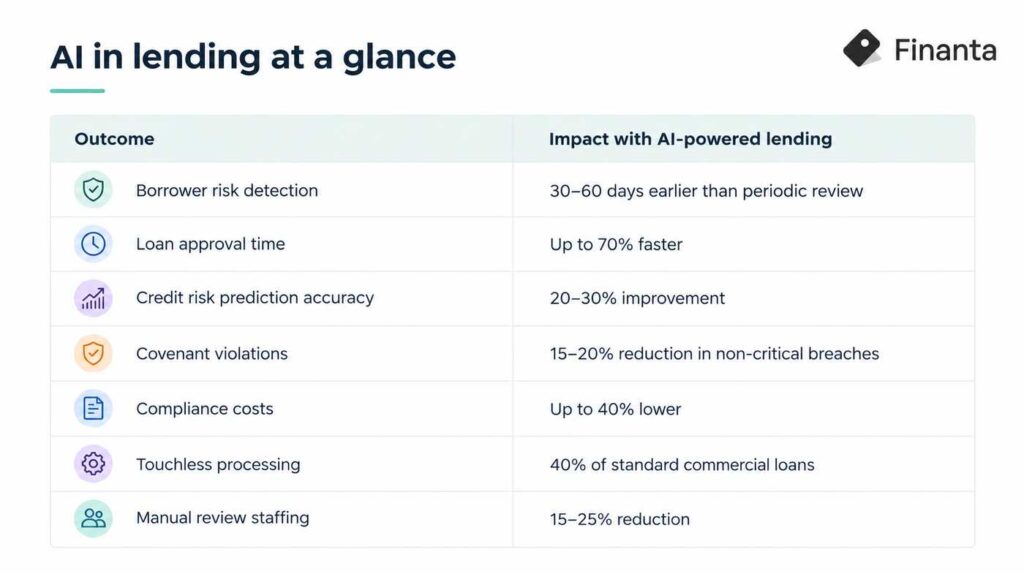
McKinsey estimates AI tools could give credit analysts 20% to 60% productivity gains on credit memos and make credit decisions around 30% faster.
AI doesn’t replace underwriters or credit committees. Regulators expect human accountability, model validation and explainable decisions.
The biggest risks are data quality, bias, explainability, data privacy and vendor risk, all of which fall under existing model risk and third-party risk guidance.
The best results come from AI built into an end-to-end lending platform, so extracted data flows into underwriting, servicing and monitoring without re-keying.
What is AI in Lending?
AI in lending refers to the use of artificial intelligence to help banks, credit unions and other lenders make the lending process faster and more data-driven. Instead of relying entirely on manual reviews, lending teams use AI to analyze borrower information, review documents, identify risks, support underwriting and monitor loans after approval.
AI in commercial lending, often called commercial lending AI, applies these tools to business loans, which are larger, more complex and more document-heavy than consumer loans. A single commercial credit can involve several entities, guarantors, years of financial statements, collateral reports and a negotiated loan agreement with covenants. That complexity is why commercial lending automation has so much room to save time, and why human judgment remains essential. The same AI for commercial lending also applies to AI for leasing and lending in equipment finance, where lease and loan files are just as document-heavy.
How AI Works Across the Commercial Lending Process
AI can support almost every stage of the commercial lending process. At each stage, AI prepares, checks or flags information, and a person reviews it and decides.
Stage
What AI does
Who decides
1. Application and intake
Collects documents through a borrower portal, checks for missing items and classifies files
Relationship manager
2. Document extraction
Reads tax returns, financial statements, rent rolls and bank statements and extracts the key figures
Analyst confirms the data
3. Data validation
Flags numbers that don’t match across documents or prior periods
Analyst resolves exceptions
4. Spreading and credit analysis
Populates spreads, calculates ratios, DSCR and global cash flow, and highlights trends
Credit analyst
5. Risk assessment
Surfaces warning signs such as falling revenue, rising leverage or concentration limits
Underwriter
6. Credit memo and approval
Drafts memo sections from the verified data, with links back to the source documents
Underwriter and credit committee
7. Closing and servicing
Extracts terms, rates and covenants from loan documents and answers routine borrower questions
Loan operations
8. Monitoring
Tests covenants, tracks financial statement deadlines and flags early warning signals across the portfolio
Portfolio manager and credit risk
In short: application → extraction → validation → spreading → risk assessment → memo and approval → closing → monitoring, with AI doing the preparation and people owning every decision.
The key to making this work is a single data model. When AI extracts data at intake, the same verified figures should feed underwriting, loan servicing and portfolio monitoring without anyone re-keying them.
10 Examples of AI in Commercial Lending
These are the most common ways banks and credit unions use AI in commercial lending today, roughly in order of how widely they’re adopted.
1. Extracting data from financial documents
AI reads tax returns, financial statements, K-1s, rent rolls and bank statements and pulls out revenue, expenses, debt and cash flow figures. For a portfolio team that spends weeks each quarter typing borrower financials into spreadsheets, this is usually the first and biggest time saving. The best tools link every extracted number back to the page it came from, so analysts and examiners can check it.
2. Automated financial spreading
Once data is extracted, AI populates standard spreads, calculates ratios, DSCR and global cash flow, and compares the borrower’s results with prior periods. Quarterly and annual re-spreading for existing borrowers becomes much faster.
3. Credit memo drafting
Generative AI drafts sections of the credit memo, such as the borrower summary, financial analysis and risk factors, from data already verified in the system. Underwriters edit and approve the draft rather than writing it from scratch. McKinsey estimates this kind of support could deliver 20% to 60% productivity gains for credit analysts (McKinsey).
4. AI commercial loan underwriting support
AI highlights the factors an underwriter should look at: declining margins, rising leverage, customer concentration, missing documents or policy exceptions. It can also flag when a new deal would push the bank over a CRE concentration limit. The underwriter applies policy and judgment; AI makes sure nothing obvious is missed.
5. Covenant extraction and monitoring
AI reads loan agreements to capture rates, repayment terms and financial covenants, then tests covenants automatically when new financials arrive. Lenders get alerts when a borrower is trending toward a breach, not months after it happens.
6. Construction draw review
On construction loans, AI can read draw requests, compare each line item with the approved budget, check that lien waivers and inspection reports are in place, and flag draws that look unusual, such as costs running ahead of construction progress. A loan officer still approves each draw, but review time drops, which matters to borrowers paying interest while a draw waits. How accurate the flags are depends on clean budget data and good inspection reports, so lenders should test them on past draws before relying on them.
7. Portfolio monitoring and early warning
AI scans borrower financials, payment behavior and covenant results across the whole book and ranks accounts that need attention. It can also surface loans approaching maturity or refinance windows without anyone reviewing every file.
8. Supporting CECL data requirements
The current expected credit loss (CECL) standard requires banks to estimate lifetime losses using loan-level history, current conditions and forecasts. AI can help collect and clean loan-level data, segment the portfolio, and extract information such as property types, LTVs and risk ratings from loan files. The loss models themselves still need validation and documented assumptions under model risk management rules.
9. Borrower support with natural language processing
Natural language processing (NLP) powers chat assistants in borrower portals that answer routine questions about payments, documents and loan status, and route complex requests to the right person. It also helps classify incoming borrower emails and documents.
10. AI agents for commercial lending workflows
AI agents can carry out multi-step tasks, such as collecting a borrower’s documents, extracting the data, checking for gaps, drafting a summary and sending it to an underwriter. Banks that use them keep credit authority with people: agents prepare and route work, but cannot approve credit, change terms or override policy. Every action is logged for audit.
Traditional vs. AI-Powered Commercial Lending
Traditional commercial lending
AI-powered commercial lending
Manual data entry from PDFs
Automated document extraction with source links
Spreads built by hand
Automated spreading and ratio calculation
Credit memos written from scratch
AI-drafted memos reviewed by underwriters
Generic covenant templates
Covenant terms extracted and tracked automatically
Periodic covenant reviews
Covenants tested as new financials arrive
Reactive portfolio management
Early warning alerts across the book
Borrower questions handled by email
Portal assistants answer routine questions
Underwriters spend time gathering data
Underwriters spend time judging credit
Benefits of AI and Commercial Lending Automation
Faster loan processing. Less time spent on document review, data entry and memo writing moves deals through the pipeline faster.
More capacity without more analysts. Teams can underwrite and monitor more loans with the same headcount, which is often the main business case.
More consistent analysis. Standard extraction and spreading reduce differences between analysts.
Better borrower experience. Fewer repeat document requests and faster answers.
Better portfolio visibility. Trends across industries, property types and loan segments are easier to see.
Stronger audit trails. Well-built tools record where each figure came from and who approved it.
What the Data Shows
Adoption is mainstream. 79% of institutions had AI pilots or AI built into lending workflows by July 2026, up from 34% in late 2025. Faster decisions were the top benefit sought; privacy and cybersecurity were the top concern (Abrigo, 2026).
Credit is a priority area. 52% of financial institutions surveyed by McKinsey said generative AI is a priority for their credit businesses, and another 39% were interested (McKinsey).
Productivity is the main prize. McKinsey estimates AI could give credit analysts 20% to 60% productivity gains on credit memos and make decisions around 30% faster. 47% of institutions named productivity as their top factor when choosing use cases.
Results aren’t automatic. A September 2026 San Francisco Fed analysis found banks using AI more heavily earned higher returns but also carried more problem loans, a reminder that governance matters as much as the technology (San Francisco Fed).
Does AI Replace Credit and Underwriting Teams?
No. In commercial lending, and especially in commercial real estate, AI replaces manual tasks, not credit judgment. It extracts and checks data, drafts analysis and flags risks, while underwriters, credit officers and loan committees keep authority over every credit decision. Most banks deploy AI in modes such as “assist” (AI suggests, a person acts) before considering any automation, and keep anything that affects approval, pricing or terms under human control.
What changes is the job. Analysts spend less time typing numbers and more time on structuring, relationships and the judgment calls that complex commercial credits need.
Risks and Challenges of AI in Lending
Data quality. AI is only as good as the documents and data it receives. Poor scans, inconsistent financials and missing fields produce unreliable output.
Accuracy and verification. Extraction and generative AI can make mistakes. Lenders need to verify AI-extracted numbers before they reach a credit memo, ideally with each figure linked to its source page.
Bias and fairness. Models can reproduce patterns in historical data. Fair lending laws, including the Equal Credit Opportunity Act, apply to business credit as well as consumer credit.
Explainability. Lenders must be able to explain why a loan was declined or priced as it was, even when complex models are involved.
Data privacy and security. Borrower and sponsor financials are highly sensitive. Lenders should confirm whether a vendor uses their data to train its models, where data is stored, and who can access it.
Integration. AI tools that sit outside the loan origination system, servicing platform or core create another place for data to diverge.
Over-reliance. Teams can start trusting outputs they no longer check. Human review needs to stay meaningful, not a rubber stamp.
How Regulators View AI in Commercial Lending
There is no separate AI rulebook for commercial lending in the US. Existing guidance applies:
Model risk management. The Federal Reserve and OCC’s SR 11-7 guidance expects models, including AI used in credit, to be validated, documented and monitored, with clear limits on how they’re used.
Third-party risk. The 2023 interagency guidance on third-party relationships treats work done by a vendor as if the bank did it itself, so AI vendors go through formal due diligence and ongoing oversight.
Fair lending and adverse action. The CFPB has said lenders must give specific reasons for credit denials even when they use complex algorithms (CFPB Circular 2022-03).
Examination readiness. Examiners increasingly ask how banks validate AI-extracted loan data. Platforms that keep defensible lineage for every field, showing the source document, any human correction and the approver, make that question easy to answer.
What to Look for in AI Commercial Lending Software
The best AI-driven platforms for commercial lending are the ones that fit into your existing workflow and stand up to an examiner’s questions. When you compare AI commercial lending solutions, look for:
Source-linked extraction. Every extracted figure links to the page it came from, with a record of any human correction.
Built into the lending workflow. AI works inside origination, underwriting, servicing and monitoring, not as a separate tool whose output has to be copied across.
Configurable control. You choose where AI only assists and where tasks can be automated, and can roll out gradually.
Human approval for credit decisions. No AI action can approve credit, change terms or override policy.
Explainability and audit trails. Clear reasons behind every flag or score, and logs of who reviewed what.
Data protection. Clear answers on data residency, access controls and whether your data trains the vendor’s models.
Integration. Works alongside your core and existing LOS or CRM, through documented APIs.
Vendor risk support. Documentation for model validation and third-party risk reviews.
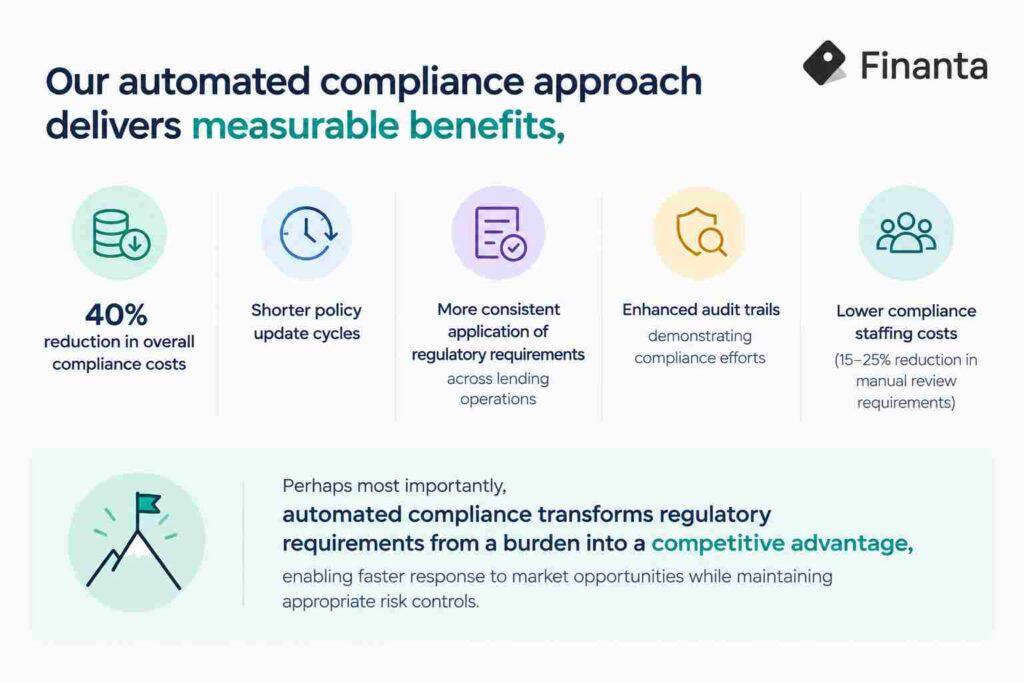
Regulatory intelligence. Monitors regulatory sources and uses natural language processing to identify requirements that may affect commercial lending policies.
Policy management. Keeps a version-controlled library of lending policies and recommends updates when regulations change, for compliance teams to review and approve.
Audit-ready documentation. Records compliance decisions and the reasoning behind them, creating a complete audit trail.
Schedule a demo to see how Finanta applies AI across your commercial lending workflow.
Conclusion
AI in commercial lending is no longer experimental. Most institutions are now piloting or using it, mainly to remove the manual work around documents, spreading, memos and monitoring. The gains are real, but they come from careful use: verified data, human credit authority, strong model and vendor governance, and AI built into the lending workflow rather than bolted on.
Lenders that adopt AI this way will process more loans with the same teams, spot problems earlier and give borrowers a faster experience, while staying ready for the examiner’s questions.
Found this useful?Share it with your team and network.
AI in commercial lending is the use of machine learning, natural language processing and generative AI to support the business loan process, from extracting data and spreading financials to drafting credit memos, monitoring covenants and answering borrower questions. It speeds up manual work while lending professionals keep responsibility for credit decisions.
What examples of AI technology are used in commercial lending?
Common examples include document data extraction, automated financial spreading, AI-drafted credit memos, underwriting risk flags, covenant extraction and monitoring, construction draw review, portfolio early warning systems, CECL data preparation, NLP-powered borrower chat assistants, and AI agents that collect and organize loan files for underwriters.
How does AI help commercial banks manage loan portfolios?
AI helps banks monitor every loan continuously instead of only at annual reviews. It spreads new borrower financials, tests covenants automatically, tracks deadlines and maturities, and ranks accounts by risk, so portfolio managers can focus on the loans that need attention first.
Does AI replace credit and underwriting teams in commercial real estate lending?
No. AI handles document review, data extraction, spreading and first drafts, but underwriters and credit committees still make every credit decision. Regulators expect human accountability, validated models and explainable decisions, so AI changes how underwriters spend their time rather than replacing them.
How can banks use AI agents in commercial lending while preserving credit authority?
Banks give AI agents preparation tasks only, such as collecting documents, extracting data, checking for gaps and drafting summaries, and route the results to people for review. Agents cannot approve credit, change terms or override policy, and every action they take is logged so the bank can show who decided what.
Can AI support a bank’s CECL data requirements for CRE loans?
Yes. AI can help gather and clean loan-level data, extract property types, LTVs, risk ratings and other attributes from loan files, and segment the CRE portfolio for loss modeling. The CECL models and assumptions themselves still need validation and documentation under model risk management guidance.
How accurate is AI draw risk flagging?
Accuracy depends on the quality of the construction budget, inspection reports and past draw data the system uses. AI is good at catching mismatches, such as costs running ahead of progress or missing lien waivers, but lenders should test it on past draws, track false positives, and keep a loan officer approving every draw.
What are the top features to look for in AI commercial lending solutions?
Look for source-linked data extraction, AI built into origination, servicing and monitoring, configurable assist and automate modes, human approval for credit decisions, explainable flags and audit trails, clear data protection terms, integration with your core and LOS, and documentation for model and vendor risk reviews.
What are the best AI-driven platforms for commercial lending?
The best AI-driven platforms for commercial lending build AI into the whole loan lifecycle, link every extracted figure to its source, keep credit decisions with people, and provide documentation for model and vendor risk reviews. End-to-end platforms such as Finanta combine AI with origination, servicing and portfolio monitoring on one data model. Compare vendors using your own sample deals.
How can automation and AI enhance productivity within commercial lending operations?
Automation and AI remove the manual steps that take up most of an analyst’s day: collecting documents, re-typing financials, building spreads, drafting memos and tracking covenants. McKinsey estimates AI could give credit analysts 20% to 60% productivity gains, which lets teams handle more loans without adding headcount.
Why are commercial lending workflows important for risk management?
Consistent workflows make sure every loan goes through the same checks, approvals and documentation, so risks are caught before closing and policy exceptions are recorded. They also create the audit trail examiners expect. AI strengthens this by flagging issues automatically at each step of the workflow.
What are the biggest challenges of AI in lending?
The main challenges are data quality, accuracy, bias and fairness, explainability, data privacy and security, integration with existing systems, and keeping human oversight meaningful. They fall under existing model risk, third-party risk and fair lending expectations.